



INDEPENDENT BUSINESS VALUATIONS
Most valuation providers only know your business, we know your industry too. With nearly 40 years of providing industry analysis our valuations go beyond telling you what your business is worth.
- Standard Valuations3-5 Business Days
- £799 + VAT
- Express Valuation24 Hours
- £999 + VAT
- Group Valuations3-5 Business Days
- from £1,999 + VAT
WHAT TO EXPECT FROM OUR VALUATIONS
Value
Business value and share value, clearly explained
Evidence
Profit, assets, liabilities and methodology set out step by step.
Context
Financial Health, benchmarks, rankings and market position.
WHAT OUR VALUATIONS CAN BE USED FOR
From succession planning to shareholder disputes, our independent valuations can be used to support important business and personal decisions, whatever your situation.

Ensure business value is fairly represented during financial negotiations with an independent valuation

Access an independent valuation to support tax planning, compliance requirements and HMRC discussions.

Resolve ownership and valuation disagreements with a clear, impartial assessment of business value.

Ensure business value is fairly represented during financial negotiations with an independent valuation.

Plan ahead with confidence by understanding the value of your business and preparing for future ownership changes.
WHAT MAKES OUR VALUATIONS DIFFERENT?
Most Valuations
 Business Value
- Share Value Where Required
 Calculation Methodology
- Limited Market Context
- Limited Competitor Comparison
- Limited View of Value Direction
Our Valuations
- Business Value
- Share Value as Standard
- Calculation Methodology
- Financial Health Review
- Industry Benchmarks
- Market Rankings
- Buyer Perspective and Acquisition Context
WHAT OUR VALUATION CUSTOMERS THINK
WHAT WE USE TO CALCULATE YOUR VALUATION
Step 1: Base profit
Step 2: Profit multiple
Step 3: Goodwill
Step 4: Assets
Step 5: Dependencies
The Result: An independent, objective and robust assessment of your company’s value provided by real people with a wealth of experience producing valuations for companies in 1800 industries worldwide.
- Standard Valuations3-5 Business Days
- £799
- Express Valuations24 Hours
- £999
- Group Valuations3-5 Business Days
- from £1,999
HOW TO GET YOUR VALUATION
Choose from Standard, Express or Group
We can supply a valuation in just 24 hours
Submit 3 Years of Accounts
This is confidential and can be done via secure file transfer
Receive Your Valuation
Sent as a PDF directly to your inbox

THE VALUE OF A PERSONAL TOUCH
Our valuations are completed by real people. Discuss your valuation needs with one of our expert analysts today.
VALUATION FAQs
A business valuation is an independent assessment of what your company is worth today, based on its financial performance, its assets and liabilities, and its position within its industry. It gives you an evidenced figure you can use with confidence, whether that's for a sale, a dispute, tax planning, or simply understanding where the business stands.
Knowing what your business is worth helps you make better decisions, whether you're planning a sale, negotiating with a co-shareholder, considering succession, or simply want to track how the business is performing over time. Many owners only think about valuation when a specific event forces the question. Having a current figure in hand can put you in a stronger position when that moment arrives.
Yes. All financial information you provide is treated as strictly confidential and used solely to prepare your valuation. We don't share your data, or your valuation report, with any third party without your written permission.
We normally require the last three years of annual accounts. If available, management accounts or financial forecasts can also be included to provide a more up-to-date valuation. Looking at several years of financial information helps us understand how the business has developed over time, and the trend in sales, profits and financial strength is often just as important as the latest year's results when assessing value.
Our standard turnaround time is typically between three and five working days after we receive the required information.
Yes. We offer an express service for clients working to tight deadlines, subject to receiving all of the required information. An additional fee applies.
Once we receive your order and the required financial information, one of our analysts begins preparing your valuation. You'll receive your completed report as a PDF directly to your inbox within the timeframe for your chosen service, and you're welcome to discuss it with the analyst afterwards if you have questions.
No. Every valuation is led and decided by a named analyst, who works with you throughout and remains responsible for the final figure. Our analysts do use technology, including AI, to support research and speed up parts of the process, but it doesn't set the value. No two businesses are the same, so every valuation is tailored to the individual business, factoring in its financial performance, market position and any additional information you provide. That judgement, backed by our database covering more than 1,600 industries, is what turns raw figures into a valuation that genuinely reflects your business, not a generic output.
Yes. We regularly value startup businesses. As there is often limited trading history, we'll normally require financial forecasts, including a projected profit and loss account and balance sheet. If required, we can provide a simple template showing the information we need.
Yes. As long as you can provide the financial information required, we can prepare an independent valuation. In most cases we'll need the last three years' profit and loss accounts and balance sheets, together with any additional information that helps explain the business.
Yes. A business can still hold value even where current profits are low or negative, for example through its assets, its market position, or its potential for recovery. Where a business is loss-making, we look closely at the underlying reasons and the relevant financial information to arrive at a realistic assessment.
A business valuation is an independent assessment of what your company is worth today, based on its financial performance, its assets and liabilities, and its position within its industry. It gives you an evidenced figure you can use with confidence, whether that's for a sale, a dispute, tax planning, or simply understanding where the business stands.
Knowing what your business is worth helps you make better decisions, whether you're planning a sale, negotiating with a co-shareholder, considering succession, or simply want to track how the business is performing over time. Many owners only think about valuation when a specific event forces the question. Having a current figure in hand can put you in a stronger position when that moment arrives.
Yes. All financial information you provide is treated as strictly confidential and used solely to prepare your valuation. We don't share your data, or your valuation report, with any third party without your written permission.
We normally require the last three years of annual accounts. If available, management accounts or financial forecasts can also be included to provide a more up-to-date valuation. Looking at several years of financial information helps us understand how the business has developed over time, and the trend in sales, profits and financial strength is often just as important as the latest year's results when assessing value.
Our standard turnaround time is typically between three and five working days after we receive the required information.
Yes. We offer an express service for clients working to tight deadlines, subject to receiving all of the required information. An additional fee applies.
Once we receive your order and the required financial information, one of our analysts begins preparing your valuation. You'll receive your completed report as a PDF directly to your inbox within the timeframe for your chosen service, and you're welcome to discuss it with the analyst afterwards if you have questions.
No. Every valuation is led and decided by a named analyst, who works with you throughout and remains responsible for the final figure. Our analysts do use technology, including AI, to support research and speed up parts of the process, but it doesn't set the value. No two businesses are the same, so every valuation is tailored to the individual business, factoring in its financial performance, market position and any additional information you provide. That judgement, backed by our database covering more than 1,600 industries, is what turns raw figures into a valuation that genuinely reflects your business, not a generic output.
Yes. We regularly value startup businesses. As there is often limited trading history, we'll normally require financial forecasts, including a projected profit and loss account and balance sheet. If required, we can provide a simple template showing the information we need.
Yes. As long as you can provide the financial information required, we can prepare an independent valuation. In most cases we'll need the last three years' profit and loss accounts and balance sheets, together with any additional information that helps explain the business.
Yes. A business can still hold value even where current profits are low or negative, for example through its assets, its market position, or its potential for recovery. Where a business is loss-making, we look closely at the underlying reasons and the relevant financial information to arrive at a realistic assessment.
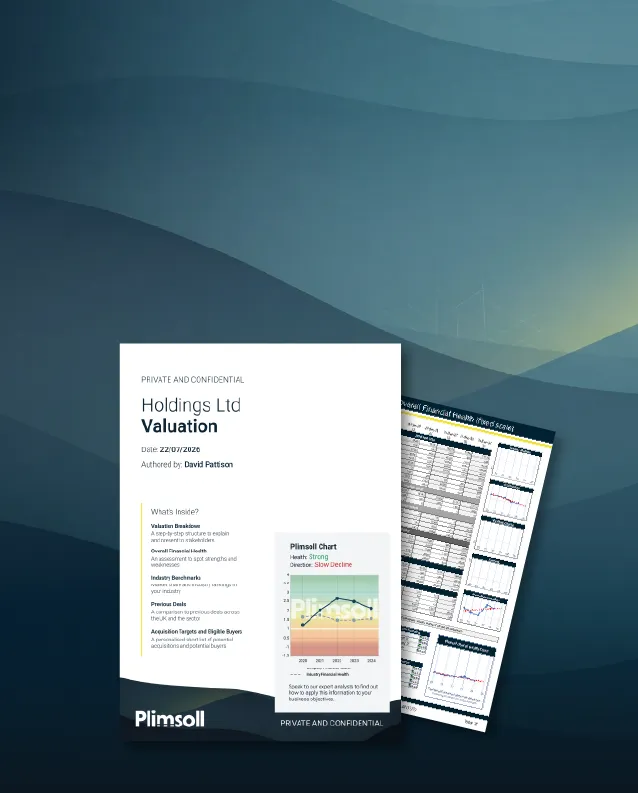
Download a Sample Valuation Report
See exactly what is included in a Plimsoll Valuation by downloading our free sample report.
Your download is ready
If it didn't start automatically, click here to download.
Discuss Your Business Valuation
Our valuations team can answer your questions and discuss any specific needs or requirements in more detail.

Thanks, we've got your details
Thank you for submitting your enquiry, one of our team will be in touch with you shortly. If your request is urgent please call us on +44 (0) 1642 626 400 or contact us via Live Chat.